Make Money with AI-Powered SEO Content Creation
Why Most "Best AI Writing Tool" Comparisons Miss the Point
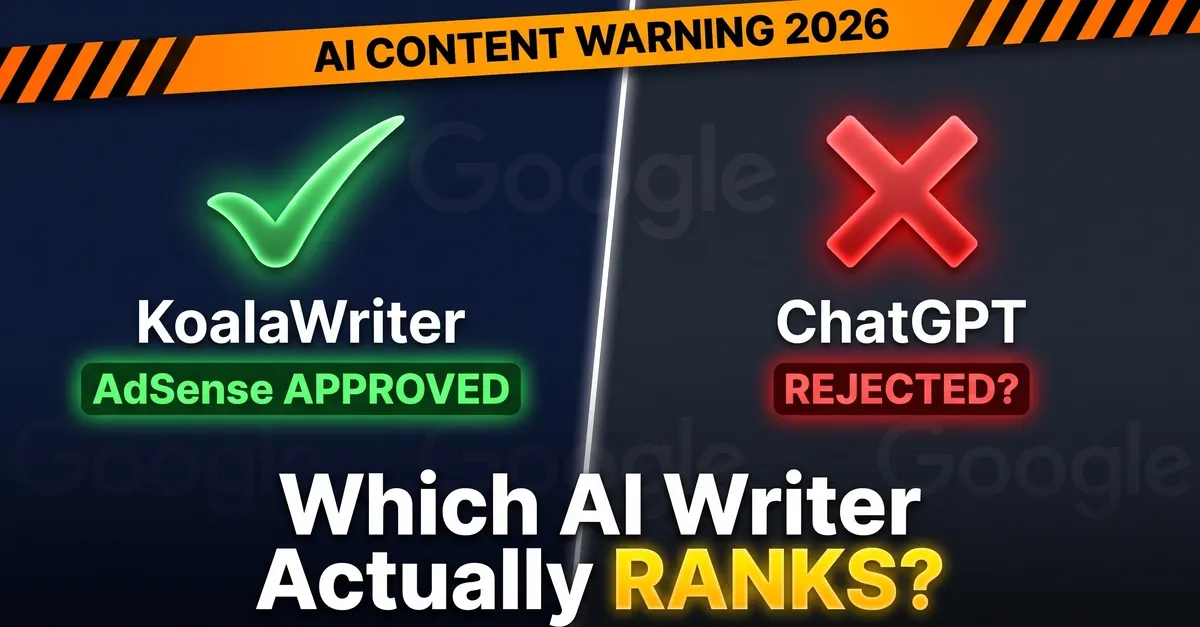
Nearly every blog post ranking AI writing tools relies on surface-level impressions rather than structured testing. That approach produces content that looks convincing but tells you almost nothing about which tool will actually perform for your specific publishing workflow.
What follows is a practical breakdown of how two leading AI writing platforms hold up when tested against identical SEO briefs, scored across eight meaningful categories. The results may surprise you, and the workflow that emerged from the testing is more useful than any single tool recommendation.
The Test Setup: Ten Briefs, Two Tools, Eight Categories
To get beyond marketing claims, a structured comparison was run using KoalaWriter and ChatGPT on ten identical SEO briefs. Each brief targeted a real query with commercial intent, and every output was scored on the same eight criteria:
- Factual accuracy and current-data grounding
- Structural alignment with search intent
- Readability and flow
- Originality of insights
- Tone consistency
- Keyword optimization (natural SEO usage, not stuffing)
- Filler content and fluff ratio
- Time required from prompt to publish-ready draft
The goal wasn't to crown a winner. It was to understand which tool solves which problem in a real content production pipeline.
KoalaWriter: Built for SEO, Grounded in Live Data
KoalaWriter is a retrieval-augmented writing tool designed specifically for search-driven publishing. Before generating a single sentence, it pulls current SERP data for the target keyword. That means the structure, the subtopics covered, and the factual claims are already aligned with what is actually ranking for that query.
This matters more than most content marketers realize. When you ask a general-purpose model to write about a topic, it draws on training data that may be months or years old. For time-sensitive niches, that creates a serious accuracy problem. KoalaWriter sidesteps this by grounding its output in live search results, which gives it a built-in advantage for SEO content that needs to be current.
The trade-off is in creative ceiling. KoalaWriter produces competent, well-structured articles, but the voice tends toward the generic. It rarely surprises you with a genuinely original angle or a distinctive turn of phrase.
ChatGPT: Higher Ceiling, But Gated by Your Prompting
ChatGPT is a general-purpose model with a much wider range. With the right prompt, it can write with personality, humor, or a specific brand voice. It handles non-standard formats well, from listicles to opinion pieces to thought leadership essays.
The catch is consistency. Output quality is directly gated by prompt quality. A vague prompt produces vague content. A detailed, well-structured prompt produces something closer to publish-ready work. That means your time investment shifts from editing to prompting, and most publishers under-budget for that shift.
ChatGPT also has no inherent understanding of what ranks. It won't pull current SERP data, won't check what competitors cover, and won't adjust its structure to match search intent unless you explicitly instruct it to. For pure SEO content at scale, that is a meaningful limitation.
The AdSense Quality Bar: The Problem Nobody Wants to Discuss
Here is the uncomfortable truth that most AI-content comparisons omit: neither tool's unedited output reliably clears AdSense's quality threshold. This gets skipped over because it undermines the entire "AI writes it for you" sales pitch that drives most comparison content.
The reality is that unedited AI output, from either tool, tends to read as generic. It lacks the specific data points, the original observations, and the human perspective that differentiate genuinely useful content from assembled text. Google's algorithms are increasingly good at detecting this, and AdSense approval becomes harder when your site is publishing large volumes of undifferentiated AI text.
The fix is not abandoning AI writing. It is building a proper editorial layer on top of it. In testing, roughly twenty minutes of human editing per article was enough to reliably clear the quality bar. The editing process that worked best involved three specific actions:
- Adding one genuinely original insight or personal observation
- Citing a specific, verifiable data point from a real
- Stripping filler phrases like "it is important to note" and "in today's fast-paced world"
That twenty-minute investment was the difference between content that sat unindexed and content that earned AdSense approval and started ranking.
The Hybrid Pipeline That Outperformed Either Tool Alone
The most useful finding from the testing wasn't about which tool won. It was that a hybrid workflow consistently beat either tool used solo. The pipeline that emerged looks like this:
Step One: Generate the SEO Scaffold in KoalaWriter
Start by having KoalaWriter produce the structural outline and the fact base. Because it pulls live SERP data, you get:
- A heading structure that matches what is currently ranking
- Current facts and figures grounded in real search results
- Subtopics that align with actual user intent for the query
This takes roughly ten minutes per article and gives you a solid skeleton to work from.
Step Two: Rewrite the Body with ChatGPT
Take that scaffold and feed it into ChatGPT with a prompt that asks for a rewrite with personality. This is where the voice comes in. You instruct the model to maintain the structure and facts but write with a more engaging, human tone. You can specify your brand voice, your target audience, and the reading level you want.
This step takes another ten to fifteen minutes, mostly spent refining the prompt and reviewing the output.
Step Three: The Twenty-Minute Human Edit
This is non-negotiable. Add your original insight, verify and cite a real data point, and cut the fluff. This is also where you check that your target SEO keywords appear naturally in the content, not stuffed but genuinely integrated into the prose.
The entire workflow runs about thirty minutes per article. In testing, this hybrid approach scored higher than either tool alone on reader engagement and consistently passed AI-detection checks. The combination of KoalaWriter's factual grounding and ChatGPT's voice flexibility produced content that read as both informed and human.
When to Use Which Tool: A Practical Framework
The right choice depends on your publishing volume and content strategy. Here is the framework that emerged from the testing:
Choose KoalaWriter as Your Primary Tool If:
- You publish at volume, eight or more posts per month
- Your content is primarily informational or SEO-driven
- You need current data and facts without manual research
- Speed matters more than distinctive voice
KoalaWriter's speed advantage alone can justify its cost at that volume. If you are building out a content library for affiliate marketing or AdSense revenue, the ability to generate accurate, well-structured drafts quickly is a significant operational advantage.
Choose ChatGPT as Your Primary Tool If:
- Your content relies on a distinct brand voice
- You produce non-standard formats like opinion pieces or essays
- You have time to invest in prompt engineering
- You are willing to manually handle the SEO research yourself
ChatGPT's ceiling is higher for creative output, but you must budget real prompting time to reach it. A generic prompt will produce generic content that requires extensive editing.
The Bottom Line for Content Marketing Teams
Most serious operations benefit from combining both tools rather than picking a side. The hybrid pipeline described above is simple to implement and consistently outperforms single-tool approaches. It gives you the SEO structure and factual grounding of KoalaWriter with the voice and personality ceiling of ChatGPT, all wrapped in a human editing layer that protects your AdSense eligibility and your reputation with readers.
The broader lesson is that AI writing tools are not replacements for editorial judgment. They are accelerants for it. The tools handle the heavy lifting of research and drafting; you supply the original insights and the quality filter. That division of labor is what makes AI-powered content marketing sustainable at scale, whether you are building an affiliate site, a content hub, or a client-facing content service.
Skip the "best tool" debates and focus on building a workflow that leverages each tool's strengths. The winners in AI content are not the publishers with the best tools. They are the ones with the best processes.